B2B & Wholesale Fulfilment UK: How to Get Retail-Ready Without Wrecking Your D2C Operation
03/09/2026 | Share:
The first wholesale order feels like a milestone, and it is. A buyer from a regional chain, a distributor, or a national retailer wants to stock your product. The volume is larger than anything you have shipped before, the margin is thinner than direct-to-consumer, and the delivery instructions run to several pages of requirements you have never encountered.
That document is where a lot of growing brands come unstuck. Retail and wholesale fulfilment is not simply “D2C but bigger boxes”. It runs on a different set of rules, a different technology stack, and a compliance regime where a mislabelled pallet or a missed delivery window can trigger chargebacks that wipe out the margin on the whole order.
This guide covers what B2B and wholesale fulfilment actually demands operationally, where in-house operations and general-purpose 3PLs tend to fall short, and how to run wholesale alongside your existing direct channel without the two pulling your stock and your team in opposite directions.
What Makes B2B Fulfilment Different from D2C
In direct-to-consumer fulfilment, you ship one or two items to an individual, quickly, in branded packaging, with the customer experience as the priority. The buyer is forgiving of small variations and rarely reads a delivery note.
Wholesale inverts almost all of that. You ship large quantities to a business, on the buyer’s terms, to a schedule the buyer controls, with compliance as the priority and the “experience” measured entirely by whether the paperwork, labelling and timing were exactly right.
Three differences drive everything else. The order profile shifts from single units to cases, cartons and pallets, which changes how goods are picked, packed and labelled. The commercial relationship shifts from a one-off sale to an ongoing account with agreed terms, purchase orders and invoicing on 30 or 60-day payment. And the compliance burden shifts from “get it to the customer” to “meet the retailer’s specification exactly”, because the retailer’s warehouse is automated and unforgiving of anything that does not scan first time.
Get any of those wrong and the consequences are financial, not just reputational. Retailers routinely levy chargebacks — deductions from your invoice — for late deliveries, incorrect labelling, missing advance notices, or booking-in failures. For a brand used to the relatively soft feedback loop of D2C, this is a sharp adjustment.
The Retailer Compliance Regime: What You’re Actually Being Asked to Do
Most first-time wholesale suppliers underestimate how much of the work is administrative and systems-based rather than physical. Here is what a typical retailer or distributor account requires.
Purchase orders and order acknowledgement
The retailer raises a purchase order, usually electronically, specifying products, quantities, delivery date and destination depot. You are expected to acknowledge it, confirm you can fulfil it, and flag any shortages before dispatch rather than letting the retailer discover them on arrival.
EDI: the language of retail
Larger retailers trade through EDI — Electronic Data Interchange — a standardised electronic messaging system that replaces emailed spreadsheets and PDFs. Purchase orders, order acknowledgements, advance shipping notices and invoices all flow as structured EDI messages between your systems and theirs. If you cannot trade EDI, many national retailers simply will not onboard you, or will charge you to use a portal instead. A fulfilment operation that already has EDI capability, or connects to an EDI provider through its warehouse management system, removes one of the biggest barriers to getting listed.
The ASN and SSCC labels
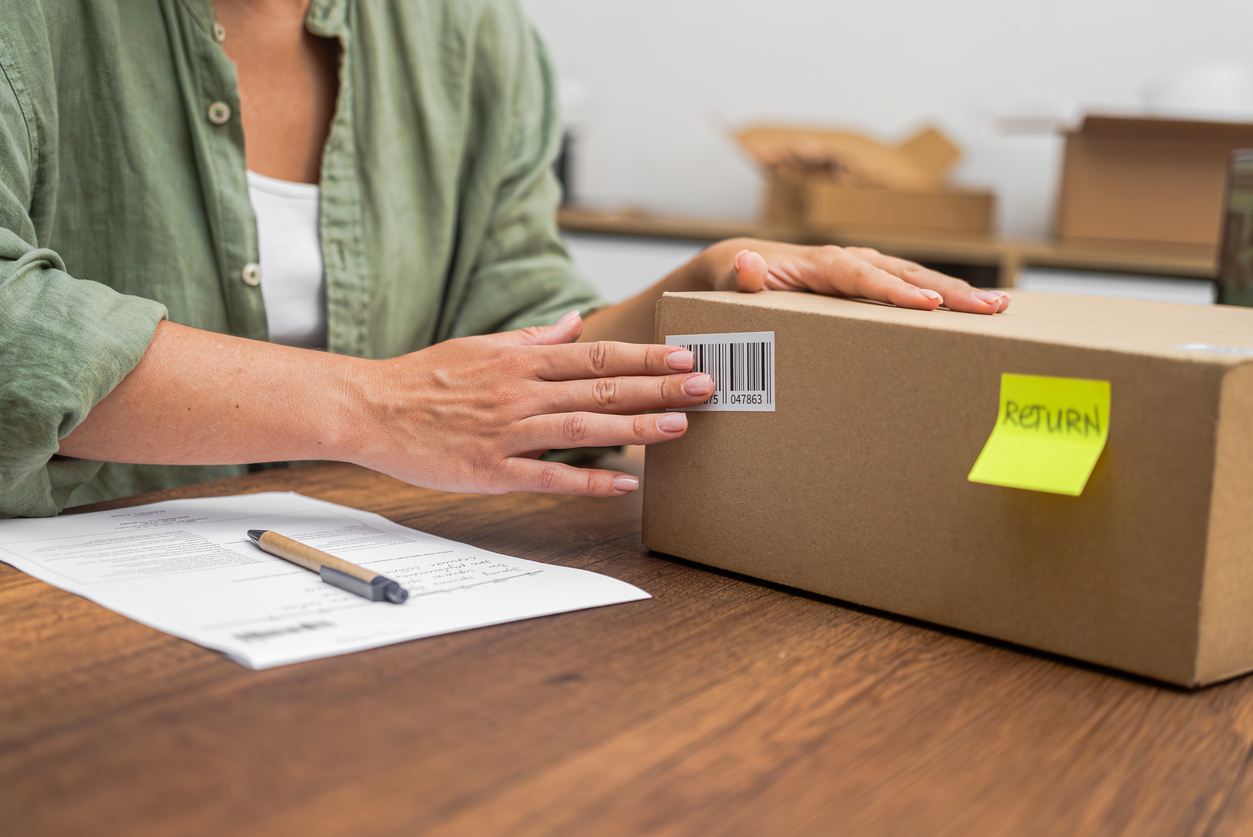
The advance shipping notice, or ASN, tells the retailer exactly what is arriving, on which pallets, before the delivery turns up. Each pallet or carton carries an SSCC label — a Serial Shipping Container Code — that the retailer’s inbound team scans to match the physical goods against the ASN. When the ASN and the SSCC scan agree, the delivery books in cleanly. When they do not, the delivery is queried, delayed or rejected, and a chargeback often follows.
Delivery windows and booking-in
Retail distribution centres do not accept deliveries whenever a courier happens to arrive. You book a delivery slot in advance, turn up within it, and if you miss it you may be turned away and rebooked days later — with the retailer treating the original date as a late delivery. Pallet networks and dedicated hauliers handle this differently from parcel couriers, which is why wholesale usually needs a different carrier mix from your D2C parcels.
Labelling and packaging specifications
Case quantities, barcode placement, outer carton labelling, pallet height and wrap, “best before” and batch traceability for consumable goods — each retailer publishes a specification, and each specification is slightly different. Meeting them consistently is a warehouse discipline, not a one-off task.
None of this is exotic once you have the right infrastructure behind it. But it is a genuinely different operation from picking a single skincare set into a branded mailer, and trying to bolt it onto a D2C-only setup is where most of the pain comes from.
Where In-House and General 3PLs Fall Short on Wholesale
If you run fulfilment in-house, wholesale exposes gaps quickly. You may not have EDI. You may be hand-keying SSCC labels or, worse, sending pallets without them. You almost certainly do not have negotiated pallet-network rates, so your carriage cost per pallet is high. And the labour to build compliant pallets, generate ASNs and book delivery slots competes directly with the team packing your direct orders — so a big wholesale order slows down your D2C dispatch exactly when you can least afford it.
A general-purpose 3PL that is set up mainly for e-commerce parcels can struggle too. Pick-and-pack systems optimised for single-item mailers are not always configured for case-level picking, pallet building or EDI trading. Ask a prospective partner directly whether they run wholesale accounts today, whether they can trade EDI, and whether they can produce compliant ASNs and SSCC labels for named retailers. Vague answers are a warning sign.
The gap is rarely capability in principle — it is whether the operation is genuinely configured and experienced in running B2B alongside D2C, or whether you would be their learning experience.
Running B2B and D2C from a Single Stock Pool
The strategic prize, and the operational challenge, is running both channels from one pool of inventory rather than splitting your stock into a “wholesale pile” and a “D2C pile”. Splitting stock physically is the intuitive move and almost always the wrong one: you end up with dead stock stranded in the wrong pile, oversells on one channel while the other sits on surplus, and constant manual rebalancing.
A properly integrated fulfilment operation holds a single stock pool and allocates from it intelligently. This is the same discipline that underpins multi-channel fulfilment across Amazon, Shopify and marketplaces — wholesale is simply another channel drawing on the same inventory, with its own order profile and SLA.
The mechanics that make this work are worth understanding. Real-time inventory visibility across every channel means a large wholesale purchase order and your live D2C store are always reading from the same accurate number, which is the foundation of avoiding oversells. Sound inventory management sits underneath the whole thing. Allocation logic lets you protect stock for a committed wholesale PO without starving your direct channel, or vice versa — a judgement call the system supports but you control. And unified reporting shows channel-level profitability, so you can see clearly whether a wholesale account is genuinely additive once you have accounted for its thinner margin and compliance overhead.
Ogden runs this model through Mintsoft, the warehouse management platform that sits behind our integrations and connects your sales channels, your stock and your dispatch into one view. The practical result is that a brand can take on a national retail listing without building a parallel operation to serve it.
How Ogden Handles Wholesale and Retail Fulfilment
Ogden Fulfilment has been a family-run business since the 1870s, and the wholesale and distribution side of fulfilment is closer to our roots than the e-commerce boom that followed. Across our three Yorkshire sites in Keighley, Saltaire and Skipton, we handle case-level and pallet-level fulfilment alongside single-parcel D2C dispatch, from the same buildings and the same stock pools.
For B2B accounts that means real capability rather than a bolt-on: case and carton picking, compliant pallet building and wrapping, SSCC labelling, ASN generation, and delivery booking through pallet networks and dedicated carriers rather than only parcel couriers. Our pick-and-pack fulfilment operation is configured for both order profiles, so a brand shipping mixed wholesale and direct volume is not forcing a square peg into a round hole.
We also apply the same responsiveness to wholesale that we apply everywhere else. Retail compliance queries — a booking that needs moving, a PO that has changed, a depot that has flagged a delivery — do not wait. Our team responds within two hours, seven days a week, because a missed booking slot on a Friday afternoon becomes a Monday problem and a chargeback if nobody picks it up. With no minimum order requirements, brands can start small on wholesale and scale as accounts grow, rather than committing to volumes they have not yet won.
Because we are multi-courier and run pallet networks alongside Royal Mail, DPD, DHL, Parcelforce and Evri, the carriage side of wholesale is costed properly rather than forced through parcel rates that make pallet delivery uneconomic. And as a B Corp with a genuine environmental programme, we can support the sustainability and packaging-reduction requirements that a growing number of retailers now write into supplier agreements.
Getting Started with Wholesale Fulfilment
If you are approaching your first wholesale accounts, a few steps de-risk the transition. Read the retailer’s supplier manual before you agree to anything, and cost the compliance requirements — EDI, labelling, delivery, chargeback exposure — into your wholesale price, because a “good” wholesale margin can evaporate once compliance costs are included. Confirm that your fulfilment operation can actually trade EDI and produce compliant ASNs and SSCC labels for your specific retailers, rather than assuming it can. And model the two channels together, so you can see whether wholesale is additive or whether it is quietly cannibalising the capacity and margin of your direct business.
Handled well, wholesale is one of the most durable growth channels a product brand has: predictable volume, committed purchase orders, and a route to shelves you cannot reach directly. Handled without the right fulfilment infrastructure, it is a source of chargebacks, stress and stranded stock. The difference is almost entirely operational — which is exactly the part a specialist partner exists to carry.
Frequently Asked Questions
What is the difference between B2B and D2C fulfilment?
D2C fulfilment ships single items or small orders directly to individual consumers, quickly and in branded packaging, with customer experience as the priority. B2B or wholesale fulfilment ships cases and pallets to businesses on the buyer’s terms, with retailer compliance — EDI, ASNs, SSCC labels and booked delivery windows — as the priority. The order profile, carrier mix and paperwork are all different.
What is an SSCC label and why does it matter?
An SSCC (Serial Shipping Container Code) label is a barcode applied to each carton or pallet that uniquely identifies it. The retailer’s inbound team scans it to match the physical delivery against the advance shipping notice you sent. If the SSCC scan and the ASN agree, the delivery books in cleanly; if they do not, it is queried or rejected, often with a chargeback.
Do I need EDI to supply UK retailers?
For most national retailers and larger distributors, yes — or you will be pushed onto a supplier portal instead, sometimes at a cost. EDI exchanges purchase orders, acknowledgements, shipping notices and invoices as structured electronic messages. A fulfilment partner that can trade EDI, or connect to an EDI provider through its warehouse system, removes one of the main barriers to getting listed.
Can I run wholesale and my online shop from the same stock?
Yes, and you should. Splitting stock into separate wholesale and D2C piles causes oversells, dead stock and constant rebalancing. A single stock pool with real-time visibility and channel allocation logic lets both channels draw from the same accurate inventory, so a large wholesale purchase order and your live store are never fighting over the same units.
What are retail chargebacks?
Chargebacks are deductions a retailer makes from your invoice when a delivery fails to meet their requirements — late arrival, incorrect or missing labelling, a missing ASN, or a failed booking. They can be significant, and on a thin wholesale margin they can erase the profit on an order. Meeting compliance consistently is the only reliable way to avoid them.
Does Ogden handle pallet deliveries as well as parcels?
Yes. Ogden builds and wraps compliant pallets, applies SSCC labels, generates ASNs and books deliveries through pallet networks and dedicated carriers, alongside standard parcel dispatch through Royal Mail, DPD, DHL, Parcelforce and Evri. Both order profiles run from the same Yorkshire sites and the same stock pool.