Pick and Pack Fulfilment Explained: How It Works, What It Costs, and What to Look For
03/03/2026 | Share:
Most e-commerce founders only think about pick and pack when something goes wrong — a customer receives the wrong item, a dispatch deadline slips, or the cost per order quietly creeps up until the margin on a £25 sale no longer makes sense.
Pick and pack is the part of fulfilment that touches every single order you ship. Get it right and customers never think about it. Get it wrong and it shows up in your reviews, your returns rate and your support inbox.
This guide walks through what pick and pack fulfilment actually involves inside a UK warehouse, what it costs in 2026, and how to tell a competent operation from a sloppy one before you commit. It is written from the floor of a working fulfilment centre — Ogden Fulfilment has been despatching orders from Yorkshire since the 1870s, and the detail here reflects how the work is really done.
What pick and pack fulfilment actually means
Pick and pack fulfilment is the process of selecting the individual items for a customer order from warehouse storage (“picking”), assembling and packaging them for shipment (“packing”), and handing the finished parcel to a courier for delivery. It sits at the centre of the wider fulfilment operation, between stock storage and courier dispatch.
The term is often shortened to “pick pack and dispatch”, which is a more accurate description of the full job. Picking and packing on their own do not get a parcel to a doorstep — the courier booking, label generation, manifesting and handover are part of the same workflow, and a good provider treats them as one continuous process rather than separate steps.
Pick and pack is a service most growing brands eventually outsource to a third-party logistics provider. Doing it well at scale needs warehouse space, trained staff, courier accounts, packing materials and software — a fixed-cost base that rarely makes sense for a brand to build itself until volumes are high and predictable.
The pick and pack workflow, stage by stage
A well-run pick and pack operation is not improvised. Every order moves through the same defined stages, and the quality of each stage determines whether the parcel arrives correct, on time and undamaged.
Receiving and goods-in
Everything starts before a single order is placed. When your stock arrives from a supplier or manufacturer, it is booked in against an expected delivery, counted, checked for damage and discrepancies, and recorded in the warehouse management system. At Ogden this runs through Mintsoft, so stock counts update in near real time and your store’s available inventory reflects what is physically on the shelf.
A sloppy goods-in process is the root cause of most downstream problems. If the count is wrong on day one, every pick after that is working from bad data.
Putaway and storage
Booked-in stock is moved to a storage location — pallet racking for bulk, shelving or bins for smaller SKUs, and dedicated pick faces for fast-moving lines. The location is recorded against the SKU so a picker can be directed straight to it.
Good warehouses organise storage around pick velocity: your best sellers sit close to the pack benches, slow movers go further out. This is invisible to you as a brand, but it is one of the biggest levers on picking speed and therefore cost.
Order capture and pick list generation
When a customer checks out on your Shopify, Amazon, eBay or TikTok Shop store, the order flows into the warehouse system through an integration. No one re-keys it. The system generates a pick list — or, more often, batches that order with others into an efficient picking run.
The speed of this handover matters. An order that lands in the warehouse system within minutes of checkout can still make a same-day or next-day cut-off. An order that sits in a nightly export cannot.
Picking — and why the pick path matters
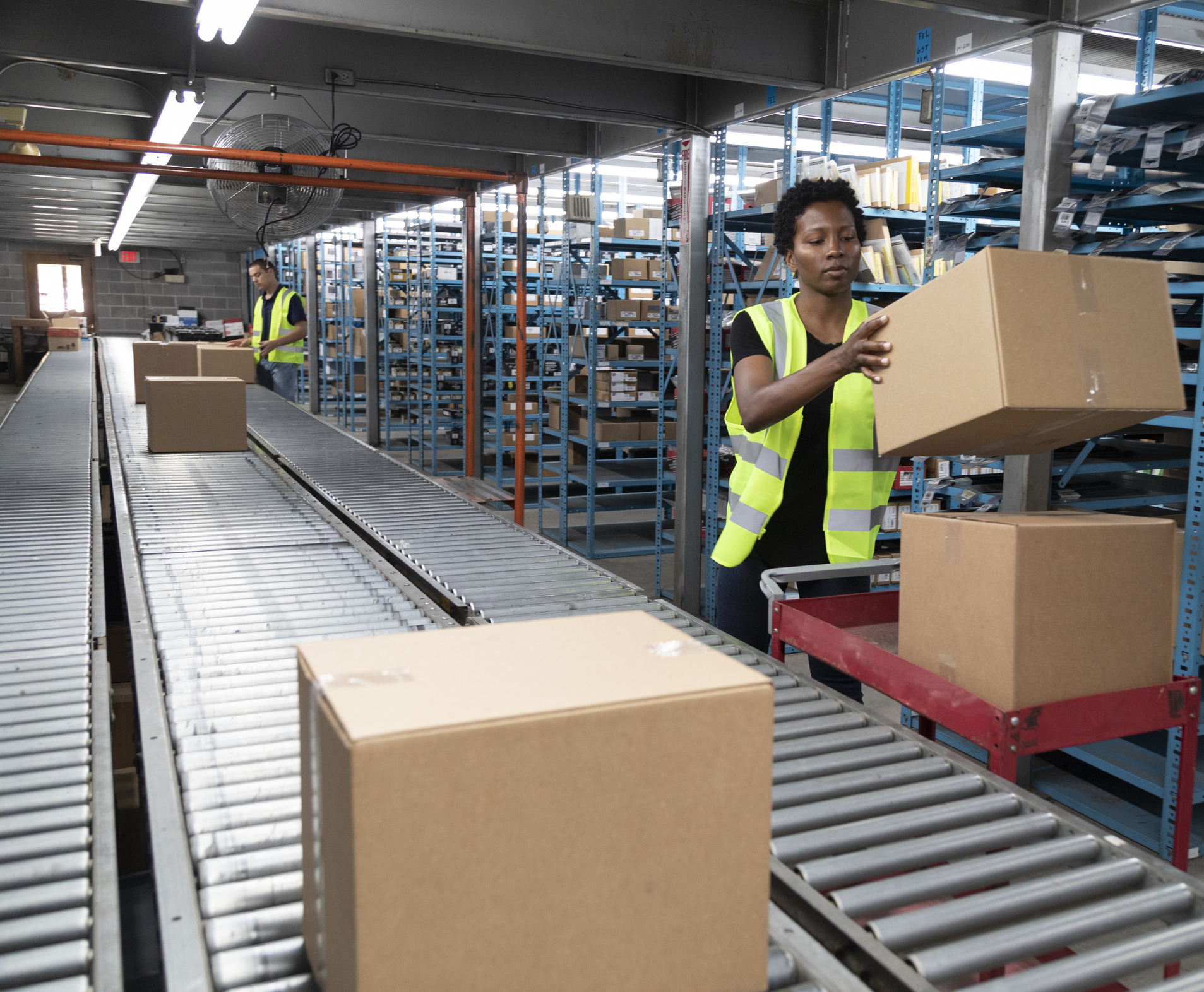
A picker is given a list of items and locations and walks the warehouse collecting them. That sounds simple, but the difference between a good and a bad operation is enormous here.
A good operation routes the picker on an efficient path, so they are not crossing the building repeatedly. It uses barcode scanning at the point of pick, so the system confirms the right SKU has been taken before it moves on. It tracks pick accuracy as a measured metric, not a hope.
A sloppy operation hands a picker a paper list, trusts them to read it correctly, and finds out about the mistake when the customer complains.
Batch picking versus single-order picking
There are two main approaches, and a capable provider uses both depending on the order profile.
Single-order picking means one picker collects one complete order at a time. It is simple and works well for large or complex orders.
Batch picking means a picker collects the items for many orders in one walk of the warehouse, which are then sorted into individual orders at a sortation or pack stage. It is far more efficient for businesses shipping a high volume of small, single-item or low-line-count orders — typical of marketplace and D2C sellers.
The right mix keeps your cost per order down. A provider that only does single-order picking will be slower and more expensive on high-volume, low-complexity profiles.
The pack station
At the pack bench, the picked items are matched to the order, the correct packaging is selected, the items are protected, any inserts or branded materials are added, and the parcel is sealed and weighed.
Packaging choice is a real decision, not an afterthought. The right box or mailer protects the product, keeps dimensional weight down (couriers charge on size as well as weight), and — for D2C brands — carries the unboxing experience. A good provider will help you specify packaging that balances protection, cost and brand.
Quality control
QC is the checkpoint that catches errors before they leave the building. At a minimum, the packer confirms the items scanned match the order. Stronger operations add weight-checking — if a parcel’s actual weight does not match its expected weight, something is wrong, and it is pulled before dispatch.
QC is also where the difference between a 99.9% accurate operation and a 98% accurate one is decided. On 5,000 orders a month, that gap is 95 wrong parcels versus five.
Courier handover and manifest
The finished parcel gets a shipping label, the tracking number is sent back to your store and the customer, and the parcel joins the day’s manifest for its courier. Multi-courier operations book each parcel to the carrier and service that best fits its size, destination and speed requirement — Royal Mail, DPD, DHL, Parcelforce or Evri — rather than forcing everything through one account.
Couriers collect on scheduled windows. Hitting those windows is what makes a “dispatched today” promise real.
What pick and pack fulfilment costs in the UK
Pick and pack pricing is usually quoted as a set of separate line items rather than a single rate. That is normal, and it is more honest than a vague “from £X” headline — but it means you need to understand each component to compare providers properly. Our full breakdown of UK fulfilment pricing goes deeper, but here is the shape of it.
|
Cost component |
Typical UK range (2026) |
What it covers |
|
First pick (first item in an order) |
£0.80 – £1.50 |
Picking the first item, pack labour, basic packaging |
|
Additional items in same order |
£0.10 – £0.40 each |
Each extra unit picked into the same parcel |
|
Pallet storage |
£10 – £30 per pallet per month |
Racked storage of bulk stock |
|
Shelf or bin storage |
Charged per location per week |
Smaller SKUs not stored on full pallets |
|
Packaging |
At cost or small mark-up |
Boxes, mailers, void fill, tape |
|
Returns handling |
£1.50 – £2.50 per return |
Receiving, inspecting, restocking or quarantining |
|
Courier |
Carrier rate, sometimes + small handling |
The delivery itself |
|
Peak surcharges |
Provider-dependent |
Q4 capacity premiums, if applied |
A few things worth knowing. First, the “first pick” rate is the headline number most providers lead with, but your real number is the all-in cost per order once additional units, packaging and courier are included. Second, watch for minimum order commitments — Ogden does not apply them, which matters for brands with seasonal or uneven volume. Third, ask directly about peak surcharges; a provider that will not quote them in advance is one to be careful with.
What separates a sharp pick and pack operation from a sloppy one
Two warehouses can quote similar rates and deliver completely different experiences. The differences show up in metrics, not marketing.
Pick accuracy is the first one. Ask for the provider’s measured pick accuracy rate and how they measure it. Anything below 99.5% on a scanned operation suggests a process problem.
Dispatch SLA performance is the second. It is not enough to know the cut-off time — ask what percentage of orders placed before cut-off actually ship that day. A good operation will tell you, because they track it.
Communication is the third, and it is the one brands underrate. When a stock discrepancy appears, a courier loses a parcel, or a peak surge hits, how fast does someone tell you and help you fix it? Ogden’s standard is a two-hour response, seven days a week — because fulfilment problems do not wait for Monday.
Integrations are the fourth. The handover between your store and the warehouse should be automatic and near real time. If a provider relies on CSV uploads or manual order entry, errors and delays are built into the model.
Finally, look at whether the provider can grow with you — into Amazon Prime-capable fulfilment, TikTok Shop dispatch SLAs, or multi-channel stock pooling — without you having to move warehouses again in eighteen months.
When outsourcing pick and pack makes sense
Bringing in a pick and pack fulfilment partner usually makes sense when packing orders is eating founder or team time that should go into product and growth, when your error rate is rising as volume climbs, when you cannot offer the dispatch speeds customers expect, or when storage has spilled out of its current space. Our complete guide to e-commerce fulfilment in the UK covers the wider decision, and our 12 questions to ask a UK fulfilment company gives you a checklist for the conversation.
The honest answer is that outsourcing is not right for every brand at every stage. A provider worth working with will tell you that — and model the numbers with you before anyone signs anything.
Frequently asked questions
What is the difference between pick and pack and fulfilment?
Fulfilment is the whole process — receiving stock, storing it, picking and packing orders, dispatching them and handling returns. Pick and pack is the specific stage where individual orders are selected, packaged and prepared for the courier. Every fulfilment operation includes pick and pack, but fulfilment covers more.
How much does pick and pack cost per order in the UK?
It depends on your order profile, but a realistic all-in figure for a typical single-item or low-line-count order — including first pick, packaging and basic handling — sits somewhere in the £1.00 to £2.00 range before courier costs. Multi-item orders cost more because of the additional pick fees. The most useful number to compare is all-in cost per order, not the headline first-pick rate.
What is batch picking?
Batch picking is when one picker collects the items for many orders in a single walk of the warehouse, which are then sorted into individual orders afterwards. It is much more efficient than picking one order at a time for businesses shipping a high volume of small orders, and it is a key reason a good 3PL can keep cost per order low.
Do pick and pack providers handle returns?
Most do, and you should expect them to. Returns handling typically covers receiving the parcel back, inspecting the item, and either restocking it as sellable or quarantining it. UK returns handling is usually charged at around £1.50 to £2.50 per return. A provider with a proper QC and re-merchandising process will recover more sellable stock for you.
Can a pick and pack warehouse meet next-day delivery cut-offs?
Yes — provided the order reaches the warehouse system quickly enough and the operation has the staffing and courier collection windows to match. The cut-off time a provider advertises is only meaningful alongside the percentage of pre-cut-off orders they actually dispatch the same day. Ask for both.
Is there a minimum order volume to use a pick and pack service?
It varies by provider. Some apply minimum monthly commitments, which can be a poor fit for new or seasonal brands. Ogden does not apply minimum orders, so the service scales with your actual volume rather than a contractual floor.