Sustainable Packaging Fulfilment UK: What’s Actually Available, and What It Costs
02/11/2026 | Share:
Sustainable packaging has moved from a nice-to-have to something a growing number of UK shoppers actively look for, and something a growing number of brands are asked about directly by customers and retail partners. The harder question is turning that intent into a fulfilment setup that still protects the product, keeps courier costs sensible, and doesn’t blow up the cost per order in the process.
This guide sets out the sustainable packaging options genuinely available to UK brands through a fulfilment partner in 2026, the real trade-offs between protection, cost and environmental impact, and how to avoid the most common mistake — switching packaging for marketing reasons without checking it still does its job. Ogden Fulfilment ships from Yorkshire and works with brands across the full spectrum of packaging priorities, from cost-first D2C sellers to brands built around sustainability as a core value.
Why packaging choice is a fulfilment decision, not just a design one
Packaging affects three things a fulfilment partner directly controls: protection of the product in transit, dimensional weight (which most couriers now charge on, alongside actual weight), and pack station speed, since some sustainable materials take longer to fold, seal or fit than a standard poly mailer. A brand can specify whatever packaging it wants, but the fulfilment partner is the one who has to make it work at pace on a working pack bench, and a good partner will flag where a packaging choice creates a real operational cost before a brand commits to it at scale.
The main sustainable packaging options
Recycled and recyclable cardboard
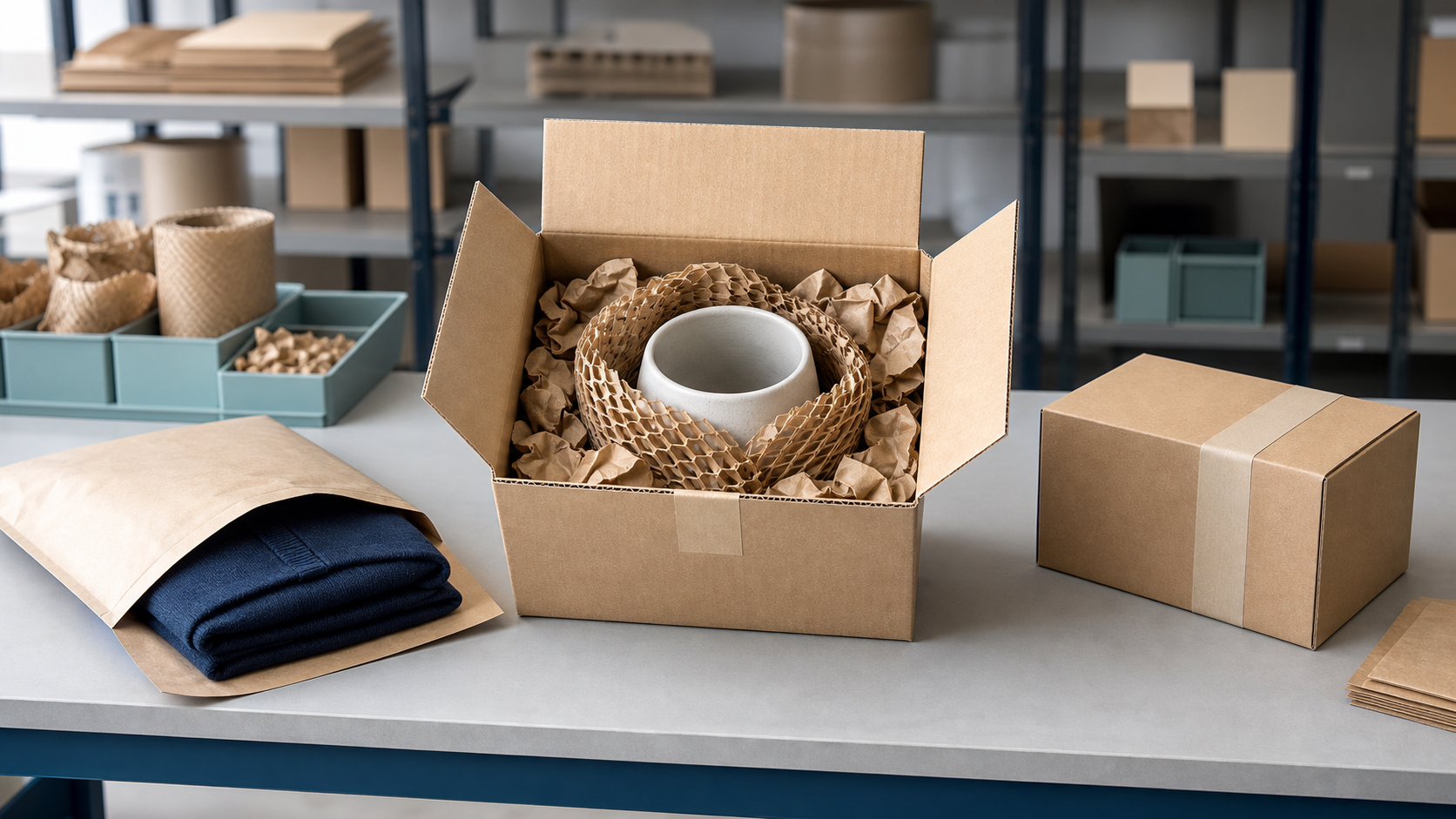
Cardboard boxes and mailers made from recycled content, and designed to be kerbside-recyclable, are the most widely available and easiest option for a 3PL to run at volume. They protect well, are familiar to pack staff, and carry only a modest cost premium over standard cardboard in most cases.
Paper mailers and padded paper envelopes
An alternative to plastic poly mailers for lightweight, non-fragile items — clothing, small accessories, printed goods. They are genuinely plastic-free and easy to recycle, but offer less water resistance and puncture protection than plastic, so they are not always suitable for every product.
Compostable and biodegradable mailers
Marketed as an alternative to standard plastic poly mailers, these need to be treated carefully — many require industrial composting conditions to actually break down, which UK household waste streams don’t generally provide, meaning a mailer labelled ‘compostable’ can still end up landfilled if the customer doesn’t have access to the right facility. Brands using these should be accurate in how they describe the disposal instructions to customers.
Reduced and right-sized packaging
Often the highest-impact and lowest-cost option: simply using a box or mailer sized correctly for the product, rather than a standard size that leaves excess void space. This reduces material use, cuts down on void-fill needs, and often reduces dimensional weight charges from the courier — a rare case where the sustainable option and the cheaper option are the same choice.
Paper-based void fill and tape
Paper honeycomb wrap, shredded paper fill and paper-based tape replace plastic bubble wrap and plastic tape without materially changing the pack process, and are one of the easier substitutions for a 3PL to make across an entire operation.
The real trade-offs
Every sustainable packaging choice trades off against something. Paper-based materials generally offer less protection against moisture and impact than plastic equivalents, which matters for fragile or liquid products more than for clothing or printed goods. Some sustainable materials are slower to fold and seal by hand than a standard poly mailer, which affects pack station throughput and, at high volume, labour cost. Compostable materials carry a real risk of consumer confusion if the disposal instructions aren’t communicated clearly and accurately. None of this is a reason to avoid sustainable packaging — it is a reason to choose the right option for the specific product rather than adopting whatever sounds best in isolation.
What sustainable packaging costs in the UK
Right-sized standard cardboard is often cost-neutral or cheaper than a one-size-fits-all box, once reduced dimensional weight charges are factored in. Recycled cardboard mailers typically carry a premium of a few pence per unit over non-recycled equivalents. Paper mailers usually cost slightly more than standard plastic poly mailers of the same size, though the gap has narrowed as demand has grown. Compostable mailers currently carry the largest premium of the mainstream options, often multiples of the cost of a standard poly mailer, reflecting a less mature supply chain. A fulfilment partner should be able to quote real per-unit costs for each option against your specific product dimensions, rather than a generic ‘eco packaging’ rate.
How to approach a switch to sustainable packaging
- Start with right-sizing, since it usually pays for itself through reduced material and dimensional weight costs before any other change is made.
- Match the material to the product — paper mailers for robust, non-fragile items; cardboard for anything needing structural protection; think carefully before using compostable formats for anything time-sensitive or liquid.
- Ask your fulfilment partner to trial new packaging on a limited run first, checking both protection in transit and pack station speed, before committing to a full switch.
- Be precise in customer-facing claims about recyclability and compostability — vague or inaccurate green claims create reputational risk that a good packaging choice was meant to avoid.
- Review courier dimensional weight rules alongside any packaging change, since a well-intentioned switch can accidentally increase shipping costs if the new packaging is larger than the old one.
Frequently asked questions
Is sustainable packaging more expensive than standard fulfilment packaging?
It depends on the option. Right-sized standard cardboard is often cost-neutral or cheaper once reduced dimensional weight charges are considered. Recycled cardboard and paper mailers carry a modest premium. Compostable mailers currently carry the largest cost premium of the mainstream options.
Are compostable mailers actually better for the environment?
It depends on disposal access. Many compostable mailers need industrial composting conditions to break down properly, which most UK household waste collection does not provide. Without access to the right facility, a compostable mailer can end up in landfill just like a standard one, so accurate customer-facing disposal guidance matters.
What is the easiest sustainable packaging change for a fulfilment operation to make?
Right-sizing packaging — using a box or mailer that actually fits the product rather than a standard oversized option — is usually the easiest change to implement and often reduces cost at the same time, through lower material use and reduced dimensional weight charges.
Does sustainable packaging protect products as well as plastic packaging?
It depends on the material and product. Paper-based options generally offer less moisture and impact protection than plastic equivalents, which matters more for fragile or liquid products than for clothing or printed goods. The right choice depends on matching material to product, not defaulting to one option across an entire range.
Can a 3PL trial new packaging before a full switch?
A capable fulfilment partner should be willing to run a limited trial of new packaging, checking both in-transit protection and pack station speed, before a brand commits to switching its entire operation.